How Much Does AI Automation Actually Cost? A No-BS Guide for Small Businesses
How Much Does AI Automation Actually Cost? A No-BS Guide for Small Businesses
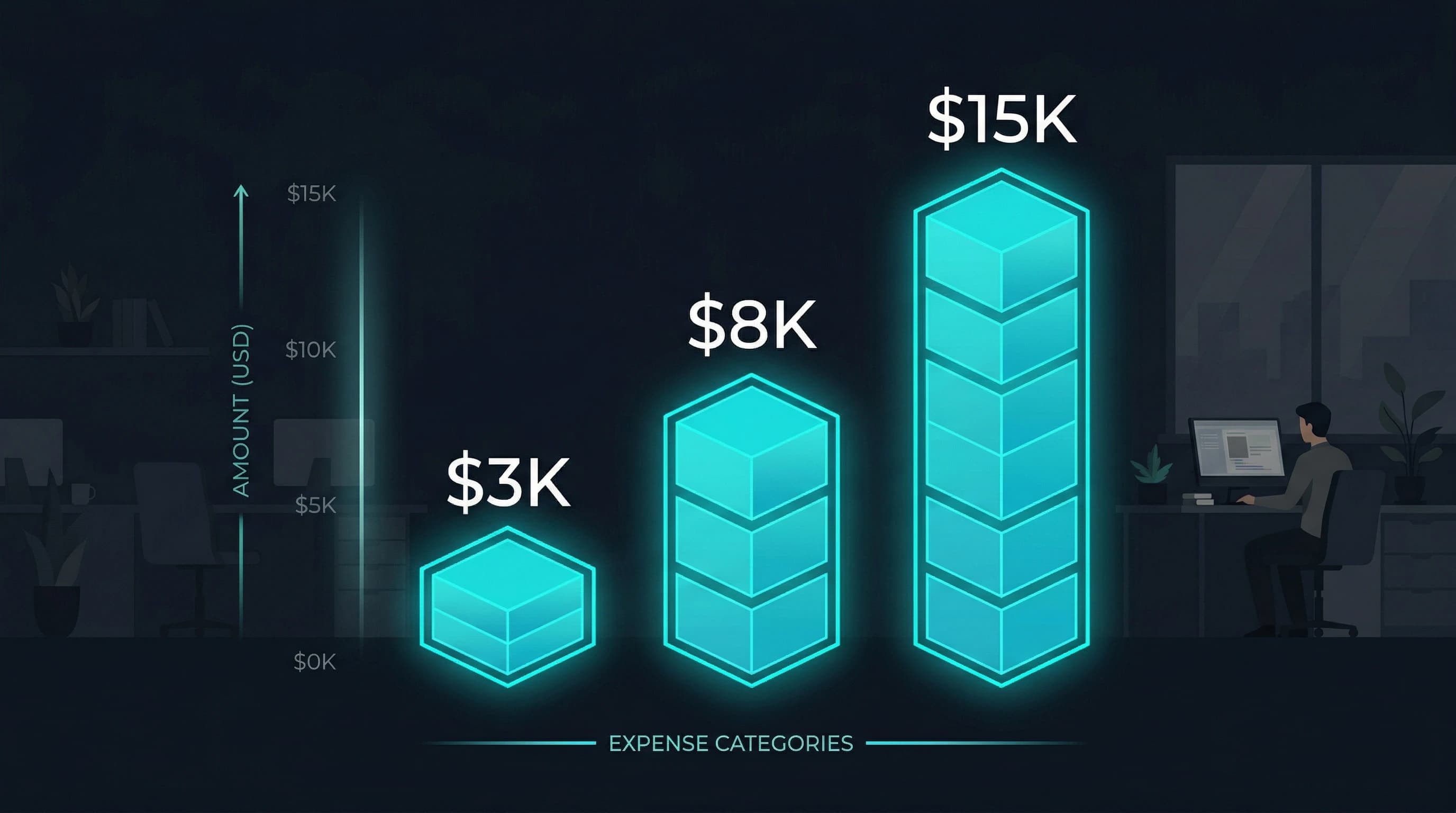
AI automation for small businesses typically costs $3,000 to $15,000 for implementation, with ongoing costs of $500 to $2,000 per month for cloud tooling and monitoring. The exact price depends on how many systems you need to connect, how complex your workflows are, and whether your data is clean enough to automate against. Most small businesses see positive ROI within 3-6 months.
That's the honest answer. Now let's break down exactly where that money goes, what hidden costs to watch for, and how to figure out whether the investment makes sense for your business.
Why Most Pricing Pages Won't Give You a Straight Answer
Most AI consultancies dodge the pricing question. They want you on a sales call before they'll talk numbers. We get it — every business is different. But after working with dozens of small businesses (5-50 employees), we've seen enough patterns to give you real ranges.
Here's what shapes the cost:
- Number of systems involved — Connecting two tools (e.g., email to CRM) is simpler than orchestrating five (e.g., orders from Shopify to QuickBooks to warehouse to shipping to customer notification)
- Data quality — If your data lives in spreadsheets with inconsistent formatting, cleanup adds cost before automation can start
- Process complexity — Straight-through processing (A triggers B) costs less than branching logic (if X, then Y, unless Z)
- Integration availability — Common platforms like QuickBooks, Shopify, and Google Workspace have ready-made connectors. Niche or legacy software may need custom API work
AI Automation Pricing Tiers for Small Businesses
Here's what we typically see across the industry for businesses with 5-50 employees:
| Project Type | Cost Range | Timeline | Examples |
|---|---|---|---|
| Simple single-workflow | $3,000 - $5,000 | 3-4 weeks | Invoice data extraction, appointment scheduling, lead notification emails |
| Multi-step workflow | $5,000 - $8,000 | 4-6 weeks | Order routing with inventory check, customer onboarding sequence, quote generation |
| Multi-system integration | $8,000 - $15,000 | 6-10 weeks | End-to-end order-to-fulfillment, dispatch optimization, full back-office automation |
Ongoing costs after the build is complete:
| Item | Monthly Cost | What It Covers |
|---|---|---|
| Cloud tooling & APIs | $200 - $800 | Platform subscriptions, API calls, hosting |
| Monitoring & maintenance | $300 - $1,200 | Performance tracking, error handling, minor adjustments |
| Total ongoing | $500 - $2,000 | Keeping everything running and optimized |
These ranges are based on real project scoping, not theoretical estimates. Your specific project may fall above or below depending on the factors listed above.
The Hidden Costs Nobody Talks About
A 2025 Fortune analysis found that the advertised price for AI automation represents only 20-40% of the true first-year cost. Here's where the rest goes:
Data Cleanup and Preparation: $500-$5,000
If your customer records have duplicate entries, your product catalog has inconsistent naming, or your invoices live in PDF format without structured data — that needs to be fixed before automation can work reliably. This is the most commonly underestimated cost.
Security and Compliance Review: $500-$2,000
For businesses handling customer data, financial records, or health information, you need to verify that the automation tools meet your compliance requirements. This includes reviewing data storage locations, encryption standards, and access controls.
Team Training and Change Management: $300-$2,000
Your team needs to understand the new workflows. This isn't just "here's a button to click" — it's helping your office manager trust the automated invoice matching or your dispatch team rely on the optimized routing. Training costs scale with team size and process complexity.
Integration Testing: $500-$1,500
Before going live, the automation needs to be tested against real (or realistic) data across all connected systems. Edge cases — the weird invoice format from that one vendor, the customer who always orders by phone — need to be handled.
The Full Picture
| Cost Category | Range | When It Hits |
|---|---|---|
| Project implementation | $3,000 - $15,000 | Upfront |
| Data cleanup | $500 - $5,000 | Before or during build |
| Security/compliance review | $500 - $2,000 | Before go-live |
| Team training | $300 - $2,000 | At launch |
| Integration testing | $500 - $1,500 | Before go-live |
| Year 1 total (with ongoing) | $11,000 - $50,000 | Spread across 12 months |
That range is wide because a 5-person accounting firm automating client document collection is a very different project from a 40-person logistics company automating dispatch, invoicing, and exception alerts.
The Cost of NOT Automating
Before the sticker shock sets in, consider what manual processes are already costing you:
- Manual data entry carries a 1-3% error rate, which costs the average small business approximately $15,000 per year in rework, corrections, and lost revenue (according to industry benchmarks)
- 86% of SMEs still enter invoice data manually, with an average processing time of 14.6 days per invoice (Institute of Finance & Management, 2024)
- 33% of B2B online orders contain errors from manual handling, leading to returns, credits, and customer churn
For a business processing 200 invoices per month manually, the math often looks like this:
| Manual Process | Hours/Week | Annual Labor Cost (at $25/hr) |
|---|---|---|
| Invoice data entry | 8 | $10,400 |
| Error correction and follow-up | 3 | $3,900 |
| Manual reporting | 2 | $2,600 |
| Total | 13 | $16,900 |
An automation project costing $8,000 upfront and $1,000/month ongoing ($20,000 in year one) pays for itself if it reclaims even 60% of those hours — plus eliminates the error costs.
How to Calculate ROI for Your Business
Here's a simple framework we use during our free process audits:
Step 1: Identify the Process
Pick the task your team spends the most hours on that follows a repeatable pattern. Common winners:
- Invoice processing and data entry
- Appointment or job scheduling
- Order routing and fulfillment updates
- Customer follow-up communications
- Report generation
Step 2: Measure Current Cost
Calculate: (hours per week) x (hourly labor cost) x 52 = annual cost
Don't forget to include error correction time, overtime, and opportunity cost (what else could that person be doing?).
Step 3: Estimate Automation Impact
Conservative benchmarks from real implementations:
- Invoice processing: Reduces processing time from 17.9 days to 3.4 days, cuts costs 40-80% per invoice (Klippa, 2026)
- Scheduling: Saves 8-12 hours per week for a 5-van service company
- Order routing: Eliminates manual errors, saves 6-10 hours per week
- Customer communications: Automates 60-80% of routine follow-ups
Step 4: Compare
If automation saves you $15,000-$25,000 per year in labor and error costs, and the project costs $10,000-$20,000 in year one (including ongoing), you're looking at a 6-12 month payback period — with compounding returns every year after.
The average return across industries is $3.70 for every $1 invested in AI automation (IBM/Aerospike, 2025). For small businesses automating high-volume processes, we often see payback in 6-8 weeks.
What Affects Price the Most (and Where to Save)
Where to invest
- High-volume, repeatable processes — The more times a task runs per day, the faster the payback
- Multi-error-prone workflows — If mistakes are costing you customers or rework, automation ROI is immediate
- Growth-blocking bottlenecks — If you can't take more clients because your admin can't keep up, automation unlocks revenue
Where to save
- Start with one process, not five — Get the first automation live and proving ROI before expanding
- Use platforms with existing connectors — QuickBooks, Shopify, Google Workspace, HubSpot all have well-built integrations that reduce custom development costs
- Clean your data first — Spending a few hours organizing your spreadsheets and standardizing your records before the project starts can save $1,000-$3,000 in data cleanup costs
When NOT to automate
Not every process is worth automating. Skip automation for:
- Tasks that happen fewer than 5 times per week
- Processes that require complex human judgment (negotiations, creative decisions)
- Workflows that change frequently (you'll spend more maintaining the automation than doing it manually)
- One-time or seasonal tasks unless the volume during peak is extreme
How to Evaluate AI Automation Pricing
When comparing proposals from consultants or agencies, ask these questions:
- Does the quote include data cleanup? If not, budget an additional 20-30% for this.
- What's included in ongoing costs? Some consultants quote low implementation fees and high monthly retainers. Others front-load the cost with lower ongoing fees.
- Who owns the automation? Make sure you own the workflows, configurations, and runbooks. You should be able to maintain or transfer them if you switch providers.
- What happens when something breaks? Understand the support SLA — response time, included fix hours, and escalation process.
- Is training included? Your team needs to understand the system well enough to troubleshoot basic issues without calling the consultant.
The Bottom Line
AI automation for a small business is not cheap, but it's not the $100K+ enterprise investment most people imagine. For most 5-50 employee businesses:
- Expect to invest $5,000-$15,000 upfront for your first meaningful automation
- Budget $500-$2,000/month for ongoing tooling and support
- Plan for 3-6 months to positive ROI, with high-volume processes paying back faster
- Account for hidden costs (data cleanup, training, testing) that add 20-40% to quoted prices
The businesses that get the best return start with one high-impact process, prove the ROI, and then expand. The ones that struggle try to automate everything at once.
Want to know what automation would cost for your specific business? We offer a free 30-minute process audit where we identify your top 3 automation opportunities and estimate the time and cost savings. No pitch, no pressure — book your audit here.